Rigorous on the technical side, close to you in the field.
Excellence as a standard, JetBrains™ certified for Kotlin.
Sharing as a driving force, creators of the first community KMP framework.
Support that lasts, our trainers also follow you on your projects.
A human-sized team, with experts available for you.
Formations certifiées
Your goals, our tailor-made training.
Kotlin, Kotlin Multiplatform, KotlinX Coroutines, Compose Multiplatform… our topics set the framework, but each program is reworked to fit your team’s level, context and challenges, in-company or in an open session.
Kotlin Multiplatform: Mobile
KotlinIntermediate
3j
Share your business logic between Android and iOS without sacrificing the native experience: master the Kotlin Multiplatform toolchain and Swift interoperability to design, distribute, and integrate a robust shared SDK that accelerates your teams.
Discover how Kotlin lets you write less code with fewer errors: its key concepts and tools will quickly make you productive at building safe, readable, and maintainable applications.
Embrace declarative thinking to build reactive, maintainable, and performant interfaces. Master state and data flow to share a single UI codebase across Android, iOS, Desktop, and Web.
Go beyond everyday Kotlin: understand the deep mechanisms of the language and compiler to write idiomatic, safe code, design durable public APIs, and automate code generation.
Go beyond everyday coroutine usage: understand their inner mechanisms, from language primitives to flows, to write reliable, performant, and testable asynchronous code, and choose the right tool for each problem.
Go beyond the simple LLM call: use Koog to design AI agents integrated into your Kotlin applications, capable of acting and orchestrating themselves, reliable, cost-efficient, and observable in production.
Finally understand what happens in your Gradle builds to make them reliable, fast, and maintainable: factor out your configuration, automate your specific needs, and save precious time on every build.
Developing with AI: Mastering and Equipping Our Agents
IABeginner
1j
Go from an assistant that generates approximate code to a true teammate: understand how AI agents reason, guide them precisely, and equip them to work faster without sacrificing the quality of your code.
Learn to build robust, maintainable Kotlin servers: secure, tested, and observable HTTP APIs with Ktor, backed by typed, performant, and scalable data access thanks to Exposed.
We recommend Kotlin Multiplatform for a simple reason: it is the only multiplatform technology that builds on your existing code.
Nothing is imposed on you. No framework, no big bang, no giving up your native interfaces. You share the part that is costly and risky to duplicate, the business logic, and you keep the rest exactly where it is today. If you want to go further, Compose Multiplatform also lets you share the UI, on the targets of your choice.
Your business logic is written and validated once. It behaves identically on iOS, Android, the web and the server.
Want us to support your project?
Training
Whether you want to build a solid foundation in Kotlin or consolidate what you know in Kotlin Multiplatform, we design tailor-made, JetBrains-certified training adapted to your team’s level.
Need to validate an architecture or secure technical choices? We support your teams in Kotlin development, with one conviction: making progress together, in a human way.
A one-off boost or a complete takeover? We develop your Android and iOS application in Kotlin Multiplatform, with the same attention to detail as on our own products.
We code. We share. We move forward with the Kotlin community.
Talks, contributions, open source libraries: the Kodein Open Source Initiative is our way of energizing the Kotlin Multiplatform community every day, with tools we maintain and that thousands of developers already use.
@Endpoint.Resource interface Tasks {
  @Endpoint.Resource interface Task : Tasks {
    val id: Uuid
  }
}
@Endpoint.Service
interface TaskService : EndpointService {
  suspend fun Tasks.Task.get()
    : Either<Task, NoFail>
  suspend fun Tasks.post(task: Task)
    : Either<Unit, UpsertTaskFailure>
}

interface TasksVIE
  : VIE<Model, Intent, NoSignal> {
  data class Model(
    val tasks: List<Task> = emptyList(),
    val isLoading: Boolean = false
  ) : VIE.Model
  sealed interface Intent : VIE.Intent {
    data class Create(val task: Task) : Intent
    data class Complete(val id: Uuid) : Intent
  }
}

@DIModule interface AppModule {
  val taskService: TaskService
}
@DIFactory(
  builds = TasksVM::class,
  from = AppModule::class,
)
internal object VMs
These articles might interest you
Tutorials, lessons learned, architecture choices: what we learn every day developing with Kotlin Multiplatform, on our projects as well as our clients’.
KotlinMultiplatformArchitectureDeep dive
7 min.
17/11/2026
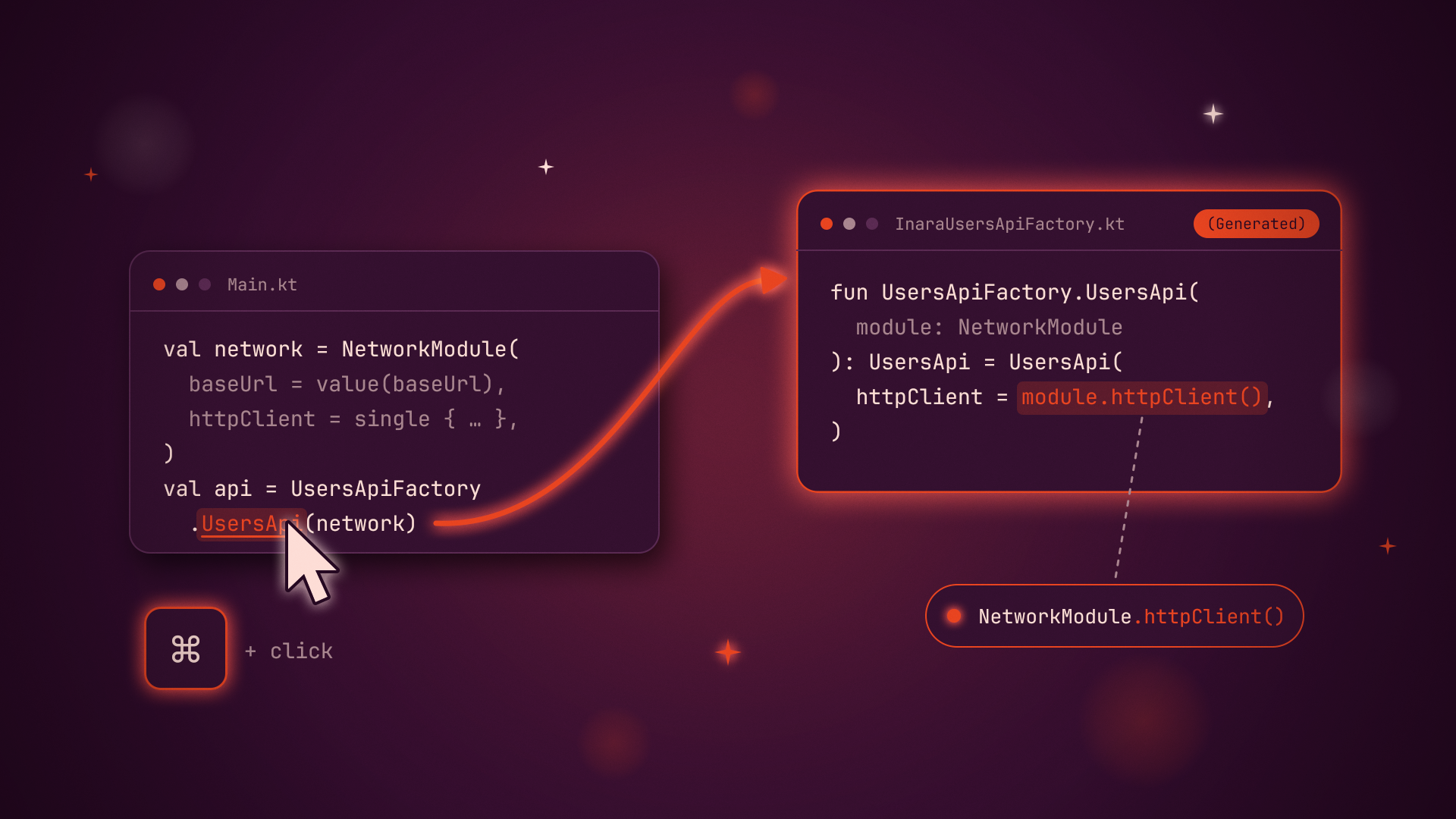
Inara has no magic: read the code it writes
In most DI frameworks, a module is an anonymous bag of bindings, and dependencies are looked up by type. Inara gives modules an identity. Let’s open the hood and read the code it generates: there is no trick, only plain Kotlin you can Cmd+click through.
I created Kodein, yet I now believe it is detrimental to the Kotlin Multiplatform ecosystem. Meet Inara, a Kotlin Symbol Processor that resolves your dependencies at compile time, and learn why we are sunsetting Kodein.
Agentic coding has killed cross-platform frameworks!
Agents made it cheap to write native code twice, so is cross-platform dead? Not quite: what changed is the question. Share what must be identical, and check it once.
AI lets me build in weeks what once took years, and it feels like a drug. Am I really creating, or just LARPing enthusiasm? A personal reflection on agency, will and shared code.
MocKMP: a mocking processor for Kotlin/Multiplatform
Want to run your unit tests on every Kotlin/Multiplatform target? MocKMP generates mocks and fakes at compile time with a Kotlin Symbol Processor, no reflection needed, and keeps a familiar mocking API.
Need to use a Swift-only iOS API such as CryptoKit in your Kotlin/Multiplatform library? Salomon shows how to bridge it through Objective-C and Kotlin/Native cinterop, with tested code.
To provide the best experiences, we use technologies like cookies to store and/or access device information. Consenting to these technologies will allow us to process data such as browsing behavior or unique IDs on this site. Not consenting or withdrawing consent, may adversely affect certain features and functions.
Functional
Always active
The technical storage or access is strictly necessary for the legitimate purpose of enabling the use of a specific service explicitly requested by the subscriber or user, or for the sole purpose of carrying out the transmission of a communication over an electronic communications network.
Preferences
The technical storage or access is necessary for the legitimate purpose of storing preferences that are not requested by the subscriber or user.
Statistics
The technical storage or access that is used exclusively for statistical purposes.The technical storage or access that is used exclusively for anonymous statistical purposes. Without a subpoena, voluntary compliance on the part of your Internet Service Provider, or additional records from a third party, information stored or retrieved for this purpose alone cannot usually be used to identify you.
Marketing
The technical storage or access is required to create user profiles to send advertising, or to track the user on a website or across several websites for similar marketing purposes.